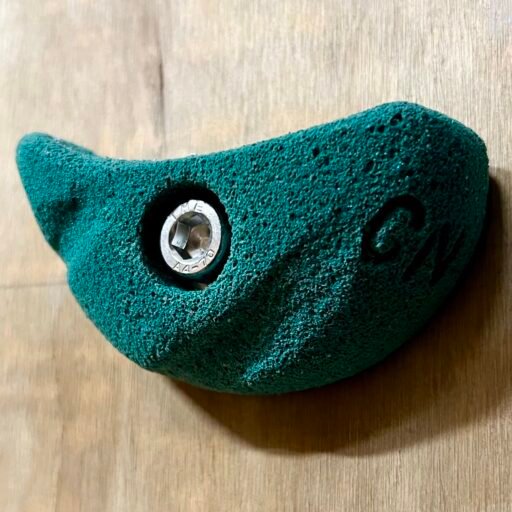
Over the last 60 years the making of climbing holds has evolved from cementing rocks into bricks to a $300m+ global industry.
1960’s and 70’s – The First Indoor Climbing Walls
The history of climbing holds is tied with the history of climbing walls. The first indoor climbing wall is widely credited as the University of Leeds climbing wall in England which was built in 1964 by Don Robinson. The holds on the wall were pieces of stone cemented into the brickwork.
Early indoor climbing followed this approach with a mixture of real rocks either bolted on or embedded in concrete or cement and chiselled wood blocks and bricks.
1980’s – The Birth of Artificial Climbing holds
In 1983 French climber and industrial engineer François Savigny started moulding holds from plastic with a bolt hole in the middle so the holds could be easily moved around. The holds were initially “shaped” out of clay, and then the hardened clay was painted with resin. This quickly evolved to resin was being poured into moulds. Savigny created EP Climbing (Entre Prises), the first company to mass produce holds.
Brands like Metolius brought these initial European manufacturing techniques and products to the United States later in the 80’s. Thee holds were made from Polyester Resin mixed with aggregate sand for friction.
1990’s – The Polyurethane Revolution
Polyester resin holds are heavy, emit toxic production fumes, and tended to chip, crack, or break under heavy climber use. In 1991, companies like Groperz began using polyurethane (PU), offering a higher strength-to-weight ratio and flexibility that prevented cracking when bolted tightly.
By the late 1990s, climbing hold manufacturers had perfected the use of advanced polyurethane blends, making holds nearly unbreakable and allowing for complex, ergonomic and much larger shapes.
Climbing Hold Maker tells you everything you need to know to make your own Polyurethane Holds.
2000’s – Volumes and macros
By the 2000’s Competition climbing was now playing a significant role in shaping hold styles and climbing walls were starting to move away from mimicking real rock. Plywood volumes which changed the shape of the wall and large macro holds helped route setters to achieve this. As holds got bigger and bigger manufacturers started using glass reinforced plastic for larger holds.
Wood holds also started making their comeback for campus boards and system training boards because of the smooth skin-friendly surfaces that could be achieved.
You can easily make your own Wood Holds and Plywood Volumes.
2010’s – Dual-Tex and Massive Macros
The 2010’s brought dual-texture (dual-tex) holds that restrict hand and foot placements to specific smooth or textured zones and even bigger macros. This further shifted indoor climbing away from mimicking outdoor rock into routes and problems that force sequences of stylized, visual movements requiring precise body positioning.
2020’s and onwards
Climbing hold making is continuing to evolve with techniques such as laser scanning holds on real rock routes to inform shapes and 3d printing of holds allowing more complex designs.
While not new the growing interest in producing environmentally friendly holds is also driving hold making to look at alternative materials such as bio-resins, mycelium (mushrooms) and using recycled or recyclable materials.